

Millennials and Generation Z report experiencing stress and mood disorders, including depression and anxiety, at a higher rate than previous generations. The new generation of adults does have to face some stress factors that previous generations did not.
The Pew Research Center defines millennials as anyone born between 1981 and 1996 (ages 24 to 39 in 2020). The next generation of adults, Gen Z, are born after 1996.
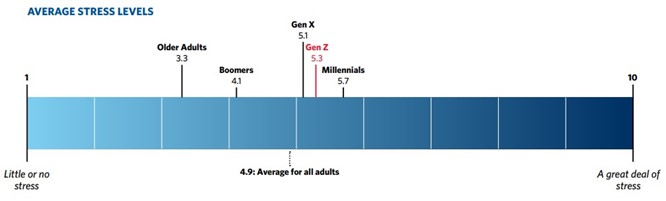
On a scale from 1 to 10 with 10 being “a great deal of stress” and 1 being “little or no stress”, Millennials and Gen Z ranked the highest, according to the American Psychological Association’s 12th annual Stress in America survey conducted in August 2018. The average score for all adults ranked at 4.9. Gen Z ranked an average of 5.3 and Millennials overtook Gen Z with an average of 5.7.
Blue Cross and Blue Shield’s (BCBS) 2017 Health Index reports, that major depression is one of the top health conditions impacting millennials. 6 out of 10 of the health conditions they experience are related to mental health and have a direct effect on their emotional wellbeing.
27% of Gen Z reported having fair or poor mental health due to stress, according to the American Psychological Association’s 12th annual Stress in America survey. 91% of Gen Z reported experiencing at least one physical or emotional symptom caused by stress compared to 74% of adults overall.
There are many personal life factors that contribute to Millennials and Gen Z experiencing more stress and behavioral health conditions than previous generations. Financial issues, social media impact, and the COVID-19 pandemic are currently some of the top factors contributing to the new generation’s rising rates of depression and anxiety.
Financial Issues
Studies report that money issues and personal debt are the top two factors that contribute to the stress and anxiety felt by millennials and Gen Z.
Millennials make less money than previous generations did at the same age. Millennials earn 20% less than Baby Boomers did at the same age, according to a new analysis of Federal Reserve data by the advocacy group Young Invincibles.
A meta-analysis study featured in the “Clinical Psychological Review” Journal, proved debt has a direct relationship with mental and neurotic disorders such as depression and panic.
41% of Gen Z feel anxious about their finances, according to the NerdWallet survey conducted in January 2020 by the Harris Poll. Anxiety was the number one emotion felt out of several emotions including nervous/confused, frustrated, and self-conscious.
According to the APA Stress in America survey, Gen Z lists money, personal debt, and the lack of money within their family households as significant stress factors.
81% reported money as a common stress factor compared to 64% of adults overall. Two out of three (63%) reported their family not having enough money as a stress factor. Although the newest generation of adults does not have high numbers of personal debt, 33% reported personal debt as a stress factor.
Mint.com reports millennials experience daily financial stress at a higher rate than any other age group. 23% of millennials report experiencing financial stress daily while 47% report feeling financial stressed only once a month.
According to a student loan survey, overall debt is a significant stressor for millennials. When asked, “What stresses you out about money?”, 39% reported too much debt as a stress factor compared to 29% who reported being able to afford rent and necessities.
Among the different types of debts, millennials reported credit cards and student loan debt as their top stressors. 27% of millennials list credit card debt as their top source of debt, student loan debt comes next with 25% reports, according to the student loan survey.
Social Media Impact
Millennials and Gen Z grew up in the age of advanced technology and social media. Social media is easily accessible with the swipe of a finger. A study conducted by healthchildren.org reports, an average of 75% of teens own a smartphone.
Emarketer reports, 90.4% of millennials and 77.5% of Gen Z are active social media users. Baby boomers (48.2%) are significantly less active compared to their younger counterparts.
Studies show social media can have a negative impact on a person’s mental health, causing an increase in anxiety and depression.
48% of Gen Z report social media making them feel sad, anxious, or depressed, according to a study conducted by Hill Holiday.
According to Pew Research Center, 42% of Gen Z and 31% of millennials reported social media having a negative effect on their self-esteem. The study also showed low self-esteem can lead to anxiety and depression.
45% of Gen Z report social media often makes them feel judged, according to the 12th annual APA Stress in America survey. 38% report feeling bad about themselves due to social media.
A national study among U.S. adults proved the use of 7 or more social media platforms increases depression and anxiety. The study showed those who use 7 or more social media platforms have a higher chance of experiencing depression and anxiety compared to those who use 0 to 2 platforms.
Social media often makes it harder for millennials and Gen Z to form relationships outside of social sites. Lacking real-life relationships can lead to a sense of loneliness and depression.
Workplace Stress
Millennials and Gen Z have a tougher path to success despite being more educated than previous generations. A college degree for millennials and Gen Z is equivalent to a high school diploma for Baby Boomers.
The pressure to attend college is directly linked to an increase in anxiety.
The declining economy leaves many young adults with fewer options for jobs and a large amount of student debt after graduation.
According to Ryan Jenkins, Millennial & Generation Z expert, 77% of Gen Z report they feel the need to work harder than previous generations to have a satisfying and fulfilling professional career.
77% of Gen Z listed work as a common stressor, the American Psychological Association reports.
A study by Bensinger, DuPont & Associates (BDA) reports, 1 in 5 millennials say they often feel depressed due to work stress.
Depression caused by work stress can lead to presenteeism. Presenteeism is the act of physically showing up to work but being unable to perform at their full capacity as a direct result of depression.
The BDA study further reports, 70% of depressed millennials in the study reported feeling presenteeism compared to 68% of Gen X and 63% of baby boomers.
“Most days I feel like I am just running on autopilot while at work,” said Kivion Wheat, a 19-year-old cook at Pizza Hut. He also states, “I feel like I spend all my time at work and still cannot afford most of my necessities without any financial help from my parents.”
COVID-19 Impact
The rapid spread of the coronavirus forced lawmakers to cancel social events, implement a 6 foot apart social distance mandate and put citizens into quarantine for long periods of time. Adults of all ages are feeling the negative effects the coronavirus is having on their mental health.
According to a survey conducted by the Benson Strategy Group, 55% of adults in America reported the coronavirus affecting their mental health either somewhat or a great deal compared to the 19% who reported the coronavirus crisis having no effect on their mental health.
Many young adults reported feeling more stressed, depressed, and anxious than ever before during the COVID-19 pandemic. COVID-19 has resulted in self-isolation and fewer social outings, resulting in an increase in loneliness and anxiety in which many Millennials and Gen Z already felt.
Before Wheat began working at Pizza Hut, his plans included going to college but the arrival of the coronavirus snatched that opportunity from him. As a class of 2020 high school graduate, he was also robbed of the chance to have a traditional graduation ceremony.
“I feel like all my dreams and goals are put on pause and it is not a good feeling,” said Wheat.
Wheat is among those who feel uncertain about the future. Studies show that uncertainty is the main cause of anxiety.
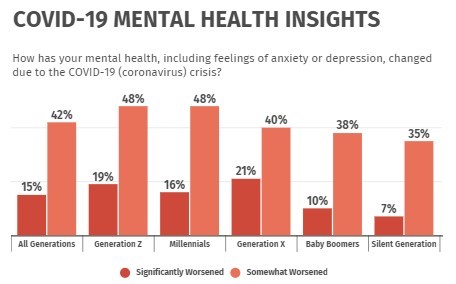
48% of Millennials say their mental health has somewhat worsened as a direct result of the coronavirus pandemic, according to a study conducted by NRC Health. 16% reported their mental health significantly worsened.
The study further states 48% of Gen Z feel their mental health somewhat worsened. 19% reported their mental health significantly worsened.
Millennials and Gen Z were already stressed and anxious about their finances, relationships, establishing their careers, and building their lives overall before the COVID-19 pandemic. The arrival of the pandemic leads to the next generation of adults feeling even more stress, depressed, and anxious than any other stage of their lives.
 Kinise Jordan
Leave a comment